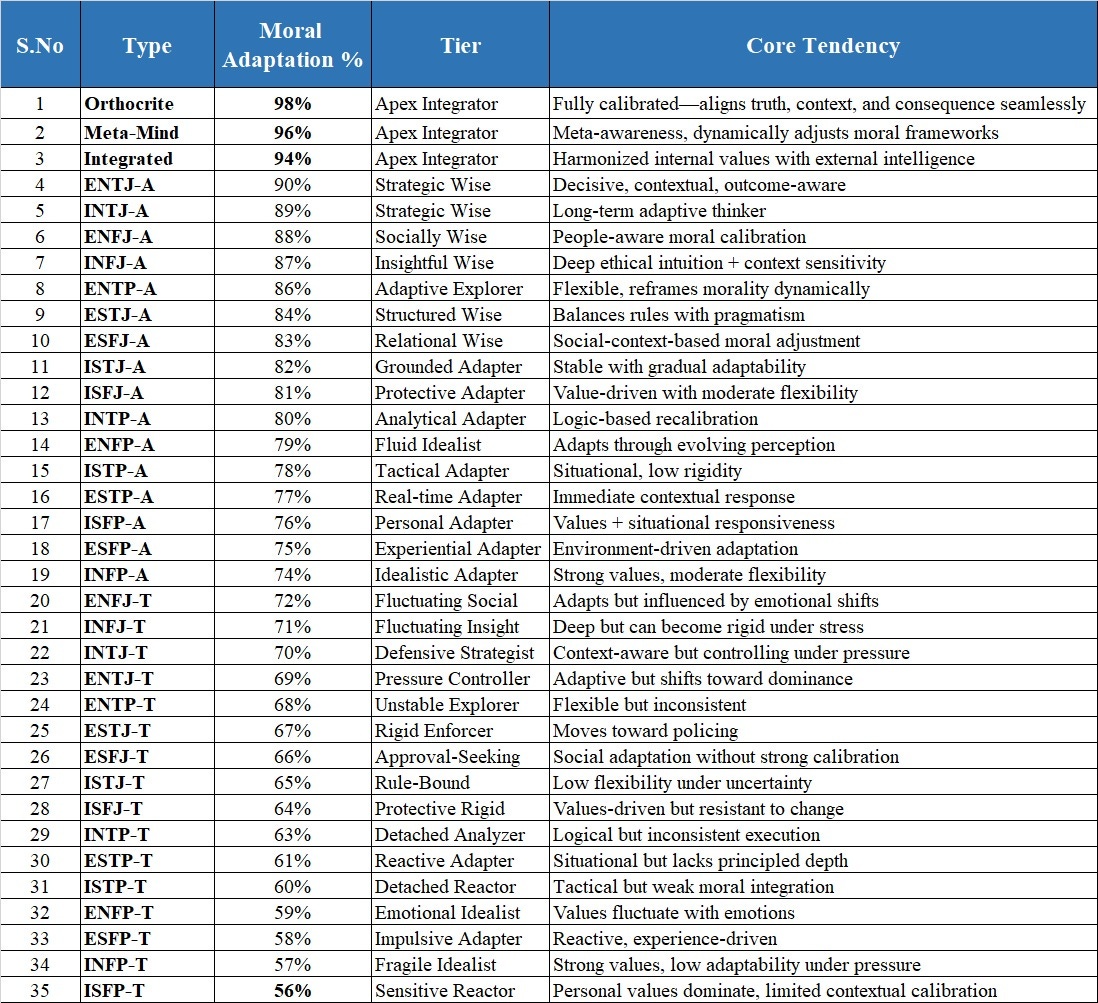
Wisdom is Moral Adaptation
The Art of Calibrating Right Action in a Complex World

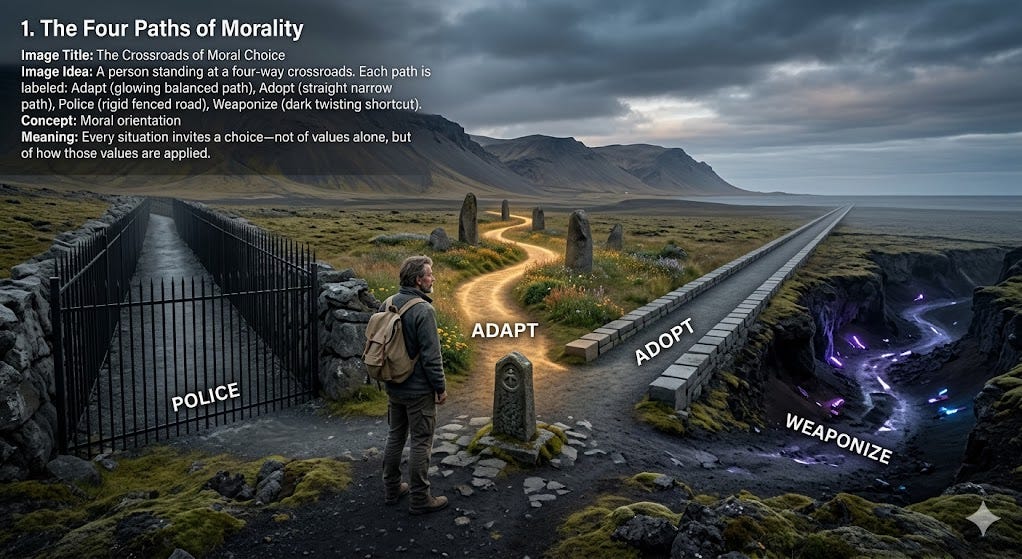
Beyond Right and Wrong
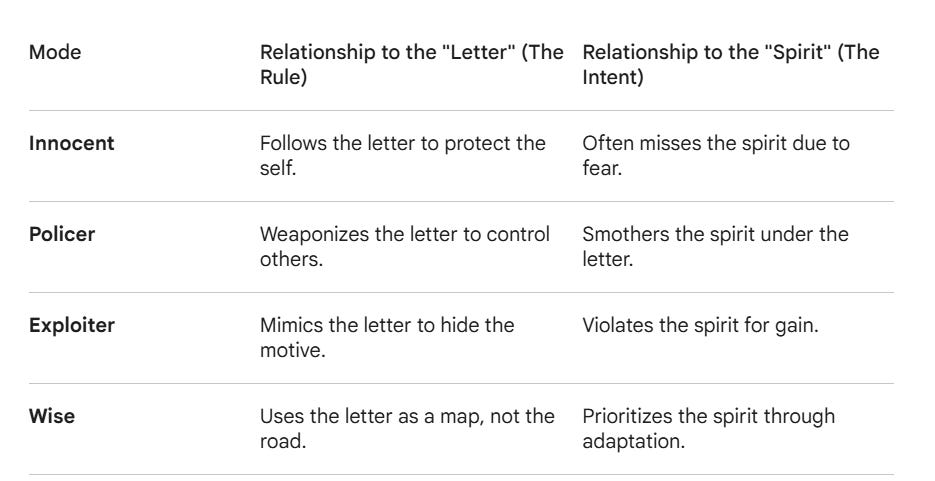
Morality is often taught as a fixed compass—pointing unwaveringly toward “right” and away from “wrong.” But real life is not a straight road; it is a shifting terrain of ambiguity, competing values, and evolving consequences. In such a world, rigid morality fractures, blind obedience falters, enforcement breeds resistance, and manipulation corrodes trust.
Wisdom, therefore, is not mere morality. It is moral adaptation.
Moral adaptation is the ability to interpret, calibrate, and apply values appropriately within context. It does not abandon principles—it refines their application. It is the difference between knowing the rule and understanding its purpose.
To understand this fully, we must examine four distinct moral orientations that shape human behavior:
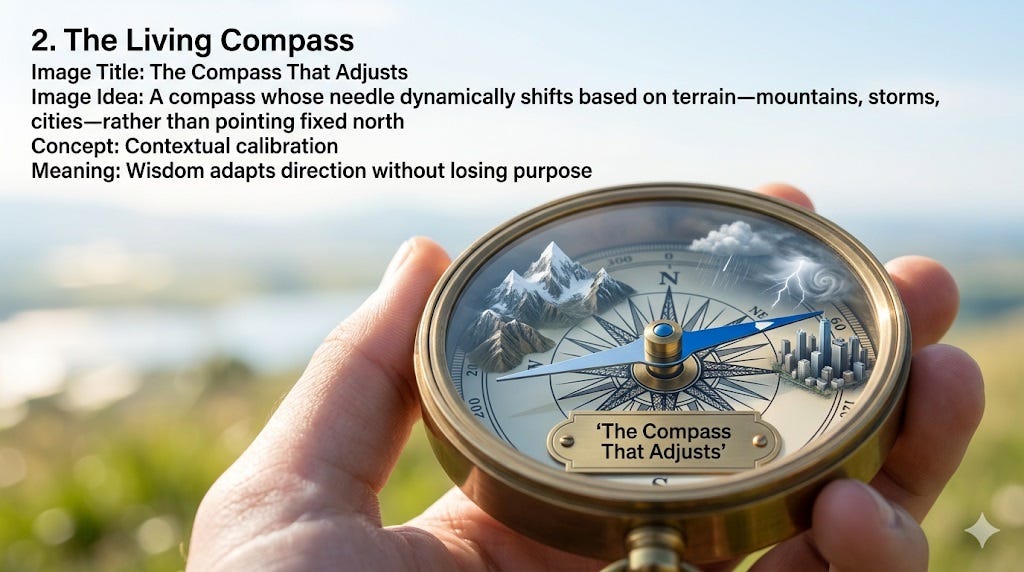
Moral Adaptation (Wise)
Moral Adoption (Innocent)
Moral Policing (Stagnant / Shadow Innocent)
Moral Weaponization (Exploiter)
These are not merely types of people, but modes of operation within each individual.
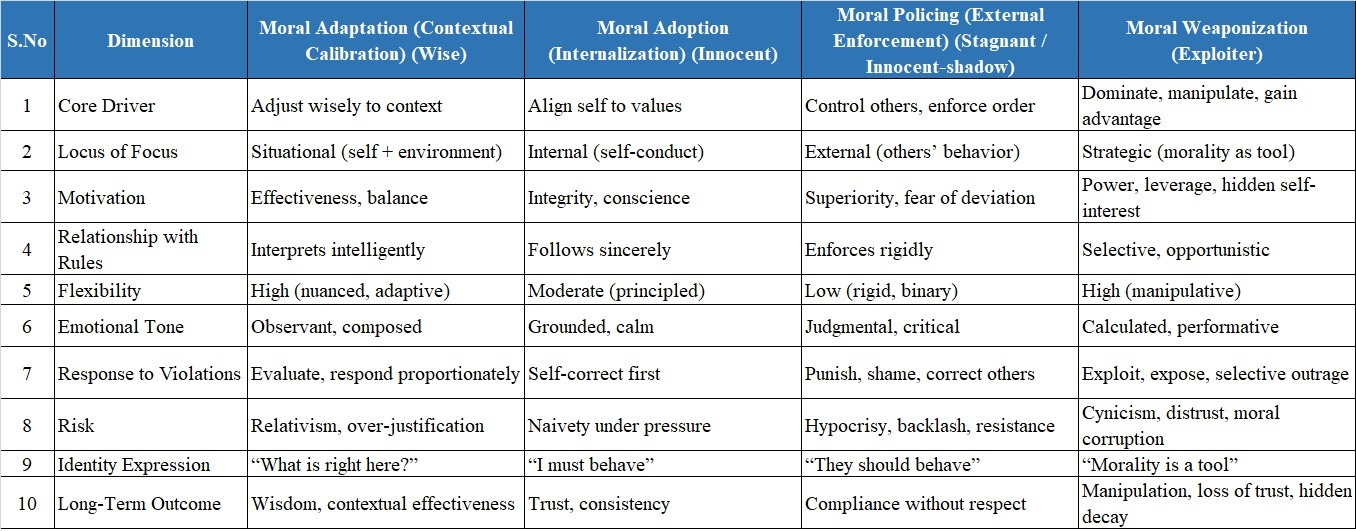
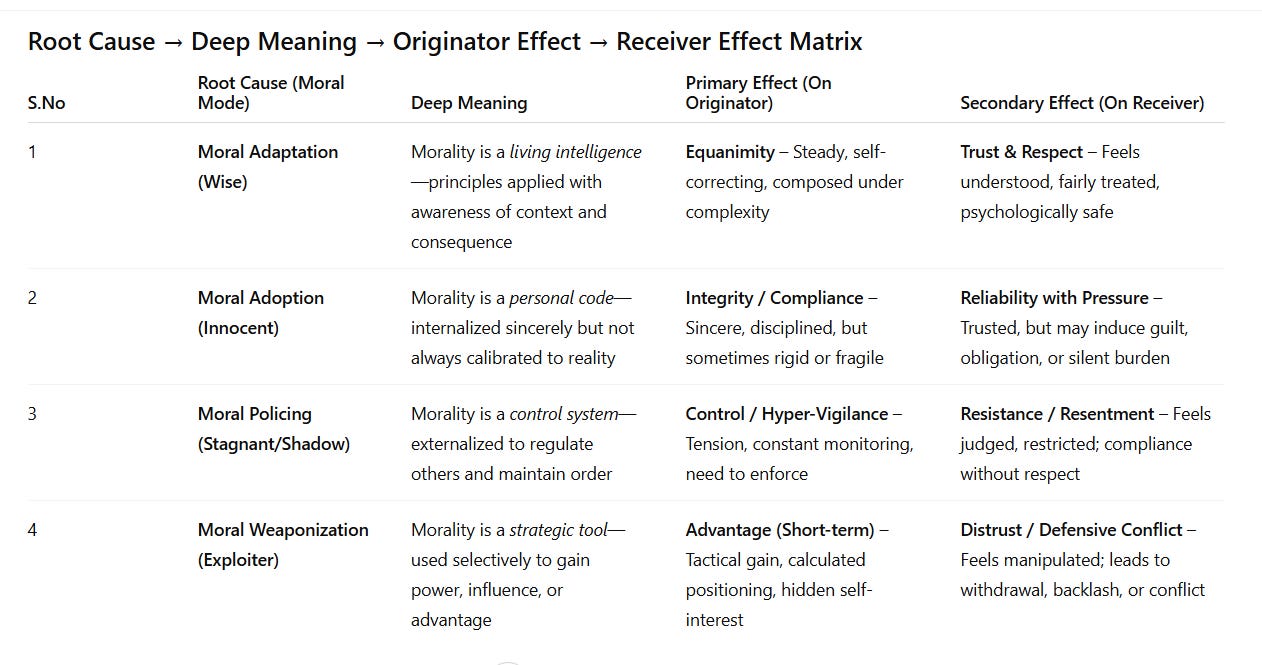
1. The Four Moral Modes: A Structural Overview
At the core, morality expresses itself through intent, focus, and behavior:
Moral Adaptation (Wise)
Adjusts principles to fit context without losing essence
Seeks balance between values and reality
Acts with awareness of consequences
Moral Adoption (Innocent)
Internalizes values deeply and sincerely
Prioritizes personal integrity
Often lacks situational flexibility
Moral Policing (Stagnant / Shadow)
Externalizes morality onto others
Enforces rules rigidly
Operates from fear of deviation or need for control
Moral Weaponization (Exploiter)
Uses morality strategically for gain
Selectively applies principles
Masks self-interest as righteousness
2. The Core Drivers: What Moves Each Mode
Each mode is driven by a fundamentally different psychological engine:
Adaptation (Wise):
“What is the right action here?”
→ Driven by effectiveness and harmonyAdoption (Innocent):
“I must behave rightly.”
→ Driven by conscience and internal alignmentPolicing (Stagnant):
“They must behave rightly.”
→ Driven by control and superiorityWeaponization (Exploiter):
“How can morality serve me?”
→ Driven by power and advantage
Insight
The same moral language—right, wrong, justice—can emerge from radically different inner motives.
3. Locus of Focus: Where Attention Flows
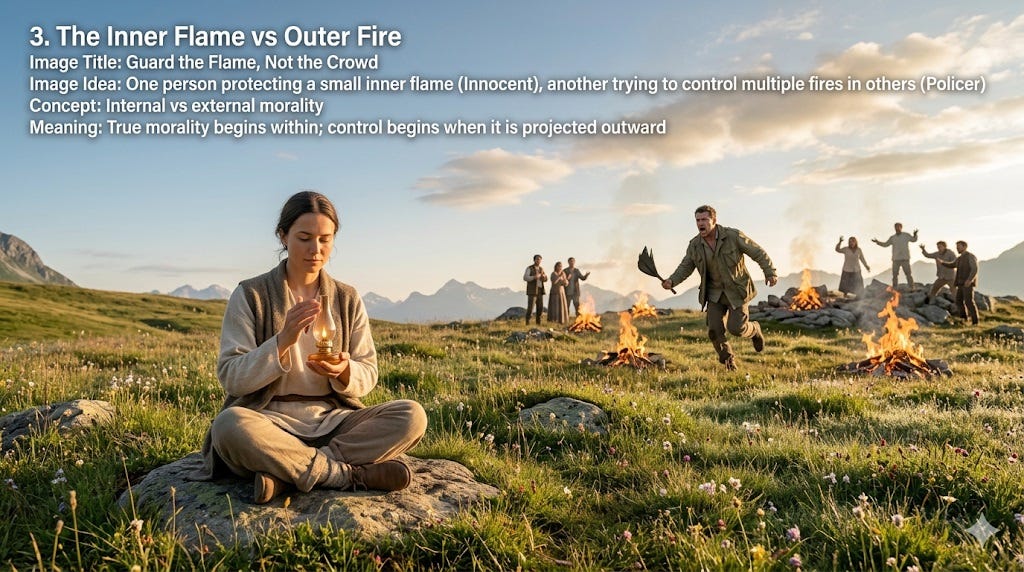
Where one places attention determines how morality manifests:
Wise: Situational awareness (self + environment)
Innocent: Internal alignment (self)
Policer: External scrutiny (others)
Exploiter: Strategic manipulation (system + perception)
Axiom
Attention defines morality in action. What you focus on determines what you distort.
4. Relationship with Rules: From Rigidity to Intelligence

Rules are not the problem—relationship with rules is.
Wise: Interprets rules intelligently
Innocent: Follows rules sincerely
Policer: Enforces rules rigidly
Exploiter: Uses rules selectively
Maxim
Rules are scaffolding; wisdom is architecture.
5. Flexibility Spectrum: Adaptation vs Distortion
Flexibility appears in both wisdom and exploitation—but with opposite intentions.
Wise Flexibility: Context-sensitive, principle-rooted
Exploiter Flexibility: Opportunistic, self-serving
Innocent Stability: Consistent, but sometimes rigid
Policer Rigidity: Binary, intolerant
Aphorism
Flexibility without integrity becomes manipulation.
Integrity without flexibility becomes fragility.
6. Emotional Tone: The Subtle Signal
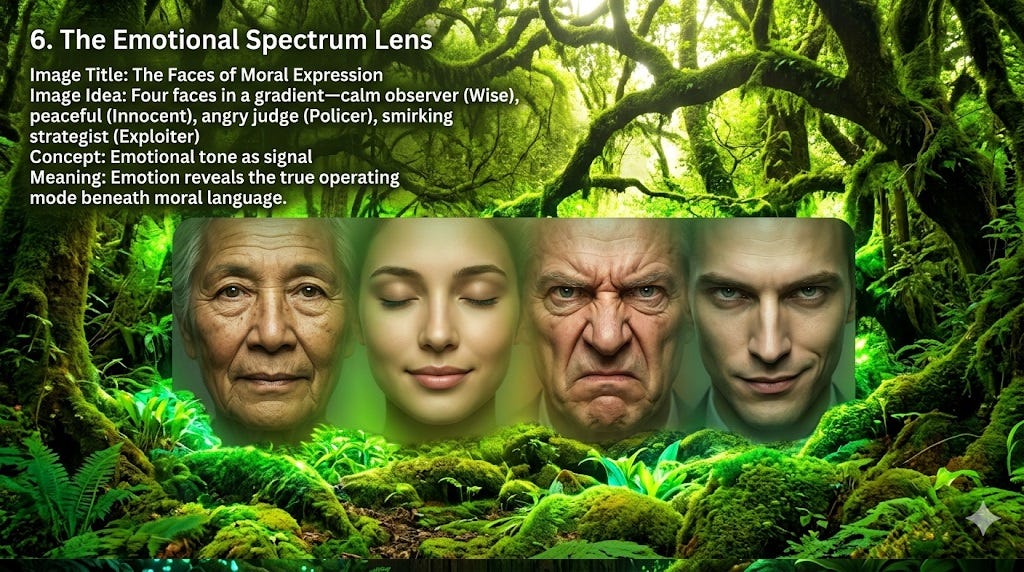
Emotion reveals the moral mode more clearly than words:
Wise: Observant, composed
Innocent: Calm, grounded
Policer: Judgmental, critical
Exploiter: Calculated, performative
Insight
The louder the moral outrage, the higher the probability of distortion.
7. Response to Violations: The Moment of Truth
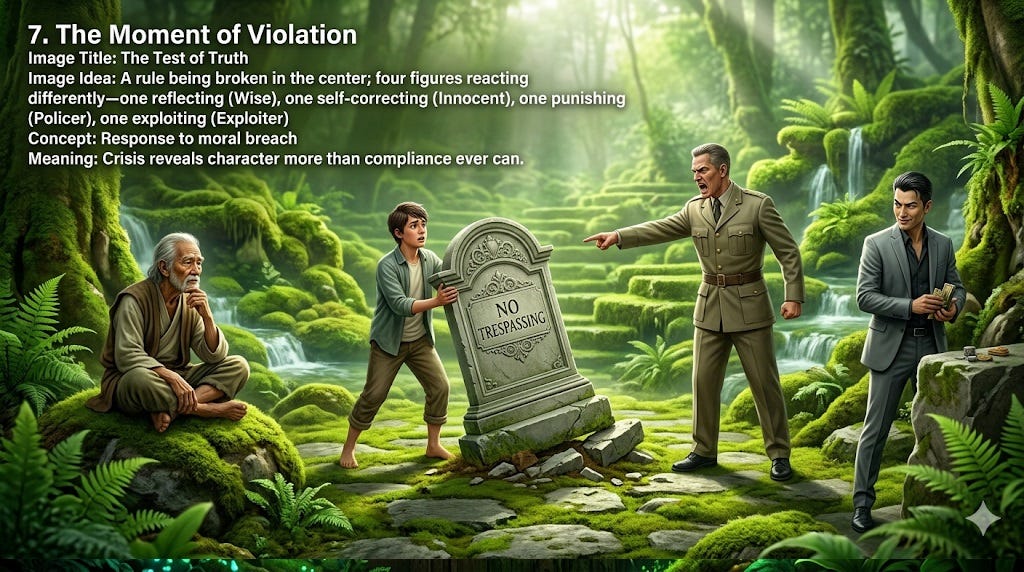
When morality is tested, true orientation emerges:
Wise: Evaluates and responds proportionately
Innocent: Self-corrects first
Policer: Punishes and shames
Exploiter: Exploits and exposes selectively
Axiom
Your response to wrongdoing reveals whether you seek justice, control, or advantage.
8. Risks of Each Mode
No mode is perfect. Each carries inherent dangers:
Moral Adaptation (Wise)
Risk of over-justification
Slipping into relativism
Moral Adoption (Innocent)
Vulnerability under pressure
Susceptibility to exploitation
Moral Policing (Stagnant)
Hypocrisy and backlash
Loss of trust and respect
Moral Weaponization (Exploiter)
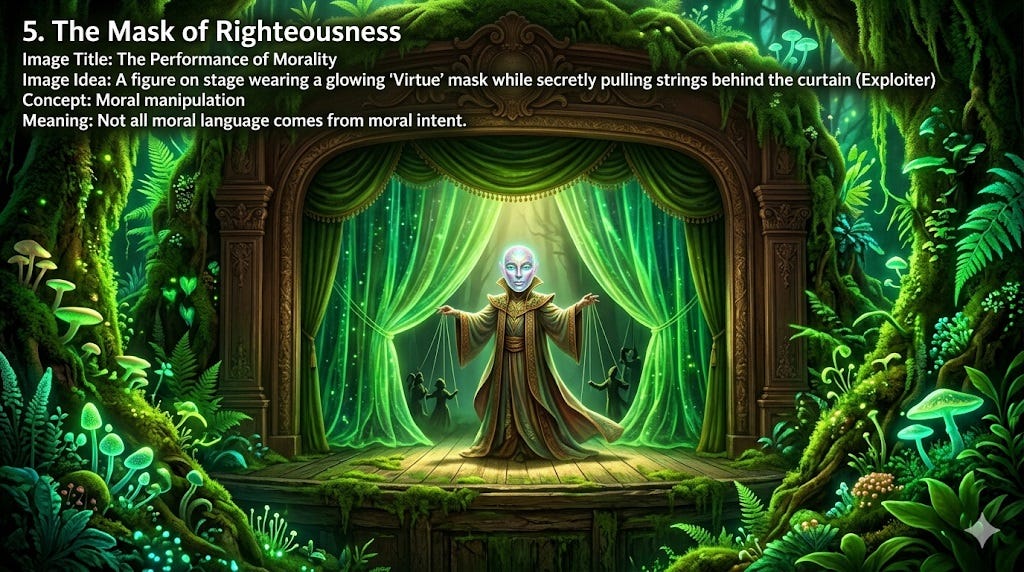
Deep cynicism
Long-term relational collapse
Maxim
Every strength, unbalanced, becomes a weakness.
9. Identity Expression: The Inner Voice
Each mode speaks a different internal language:
Wise: “What is right here?”
Innocent: “I must be right.”
Policer: “They must be right.”
Exploiter: “Rightness is useful.”
Aphorism
The shift from “must” to “understand” marks the birth of wisdom.
10. Long-Term Outcomes: Where Each Path Leads
Time exposes the truth of each approach:
Wise: Builds wisdom, effectiveness, and respect
Innocent: Builds trust and consistency
Policer: Produces compliance without respect
Exploiter: Gains short-term advantage, loses long-term trust
Insight
Trust grows from integrity applied wisely—not loudly.
11. The Interplay of the Four Modes
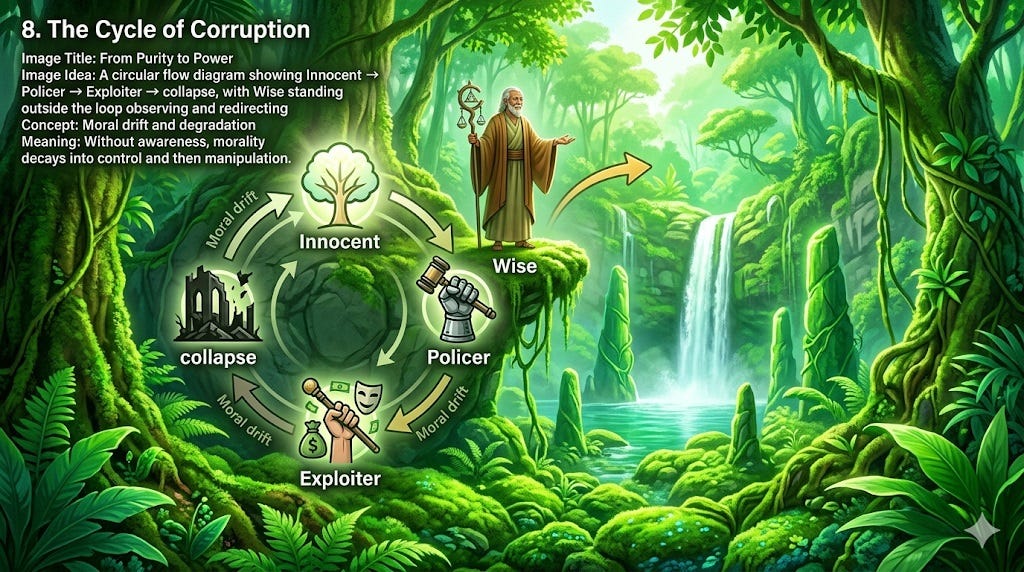
These four are not isolated—they constantly interact within individuals and societies.
1. Innocent → Policer (Shadow Shift)
When the innocent feels threatened or ignored:
Internal morality turns outward
Guidance becomes enforcement
Care becomes control
2. Policer → Exploiter (Corruption Drift)
When enforcement becomes self-serving:
Rules become tools of dominance
Authority becomes manipulation
3. Innocent → Exploited
When sincerity lacks discernment:
The exploiter uses moral language to gain advantage
The innocent becomes a resource
4. Wise as Integrator
The wise:
Learns sincerity from the innocent
Avoids rigidity of the policer
Sees through the manipulations of the exploiter
Adapts without losing ethical grounding
Axiom
Wisdom does not reject the other modes—it integrates and transcends them.
12. The Architecture of Moral Adaptation
To operate wisely, one must develop three layers:
1. Principle Clarity
Know your core values
Understand their purpose, not just their form
2. Context Awareness
Read the situation accurately
Consider consequences and trade-offs
3. Calibrated Action
Apply values proportionately
Balance firmness with flexibility
Bullet Framework: The Wise Calibration Loop
Observe reality without bias
Interpret through principles
Evaluate consequences
Act proportionately
Reflect and refine
13. Practical Insights for Daily Life
When dealing with others:
Avoid immediate judgment (policer tendency)
Avoid blind trust (innocent vulnerability)
Detect hidden agendas (exploiter awareness)
Respond proportionately (wise action)
When dealing with self:
Maintain integrity (innocent strength)
Question rigidity (policer shadow)
Check hidden motives (exploiter within)
Adapt consciously (wise evolution)
14. Axioms of Moral Adaptation
Context does not cancel truth—it refines its application.
Principles guide; wisdom decides.
Morality without awareness becomes noise.
Judgment without understanding becomes injustice.
Power without ethics becomes exploitation.

15. Closing Reflection: The Living Nature of Morality
Morality is not a static code etched in stone—it is a living intelligence. It breathes through context, evolves through experience, and matures through reflection.
The innocent preserves morality.
The policer defends morality.
The exploiter distorts morality.
But the wise animates morality.
Final Aphorism
Wisdom is not in knowing what is right.
It is in knowing what is right—here, now, and why.
In a world of rigid rules, loud judgments, and hidden manipulations, moral adaptation stands as the highest form of ethical intelligence. It is not compromise—it is calibrated integrity.
And that is what makes it wisdom.