
Define or Be Defined
How a Healthy Ego Establishes Identity While an Unhealthy Ego Surrenders It

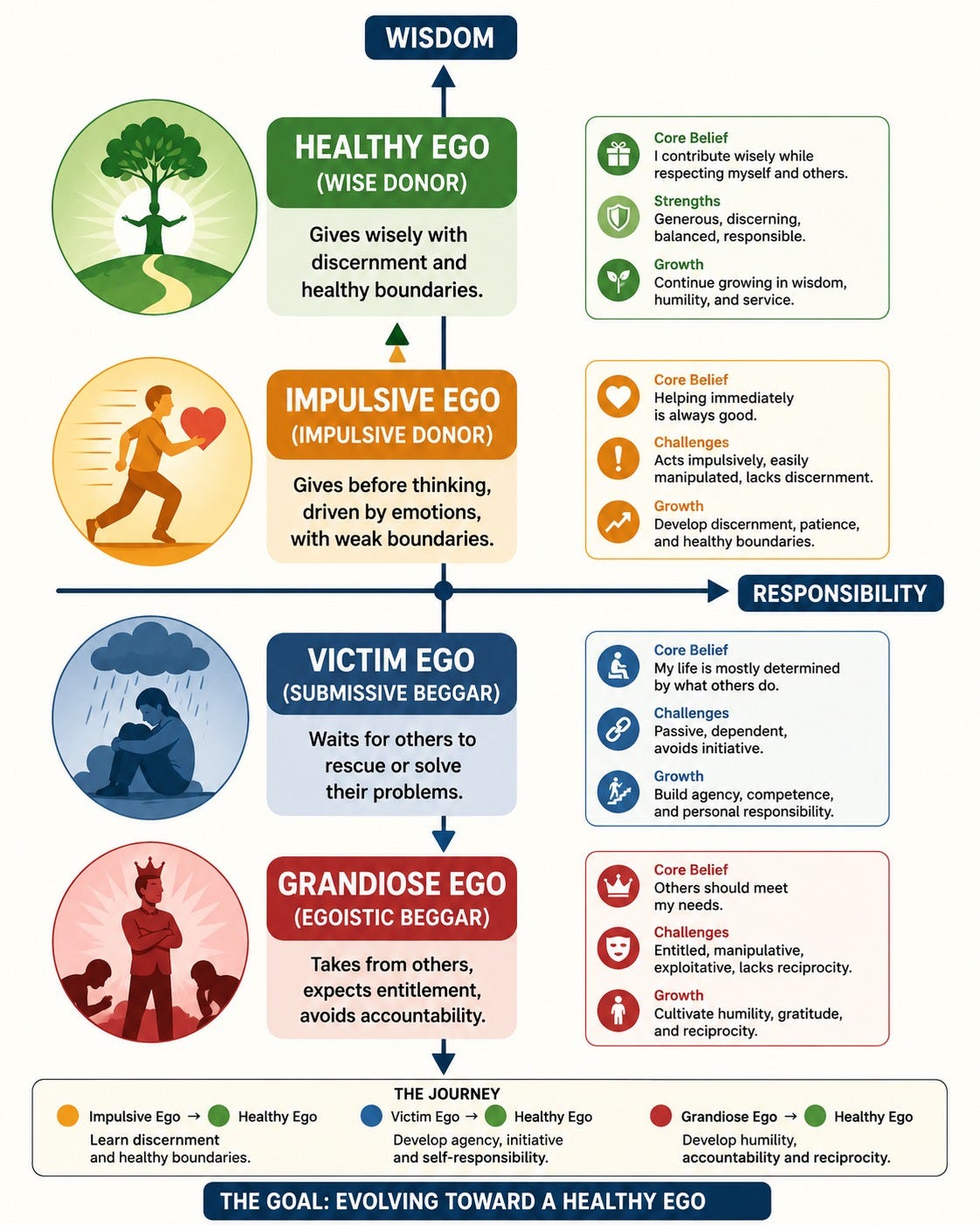
Introduction: The Invisible Battle Over Identity

Every human interaction involves more than words, emotions, or actions. Beneath every conversation lies an invisible negotiation over identity, responsibility, boundaries, and reality. Whether we realize it or not, every relationship asks a silent question:
“Who will define whom?”
Those who possess a healthy ego define themselves through principles, values, and truth. Those who lack a healthy ego gradually allow others to define their identity, responsibilities, emotions, and even their perception of reality.
This is one of the most important laws of psychological maturity:
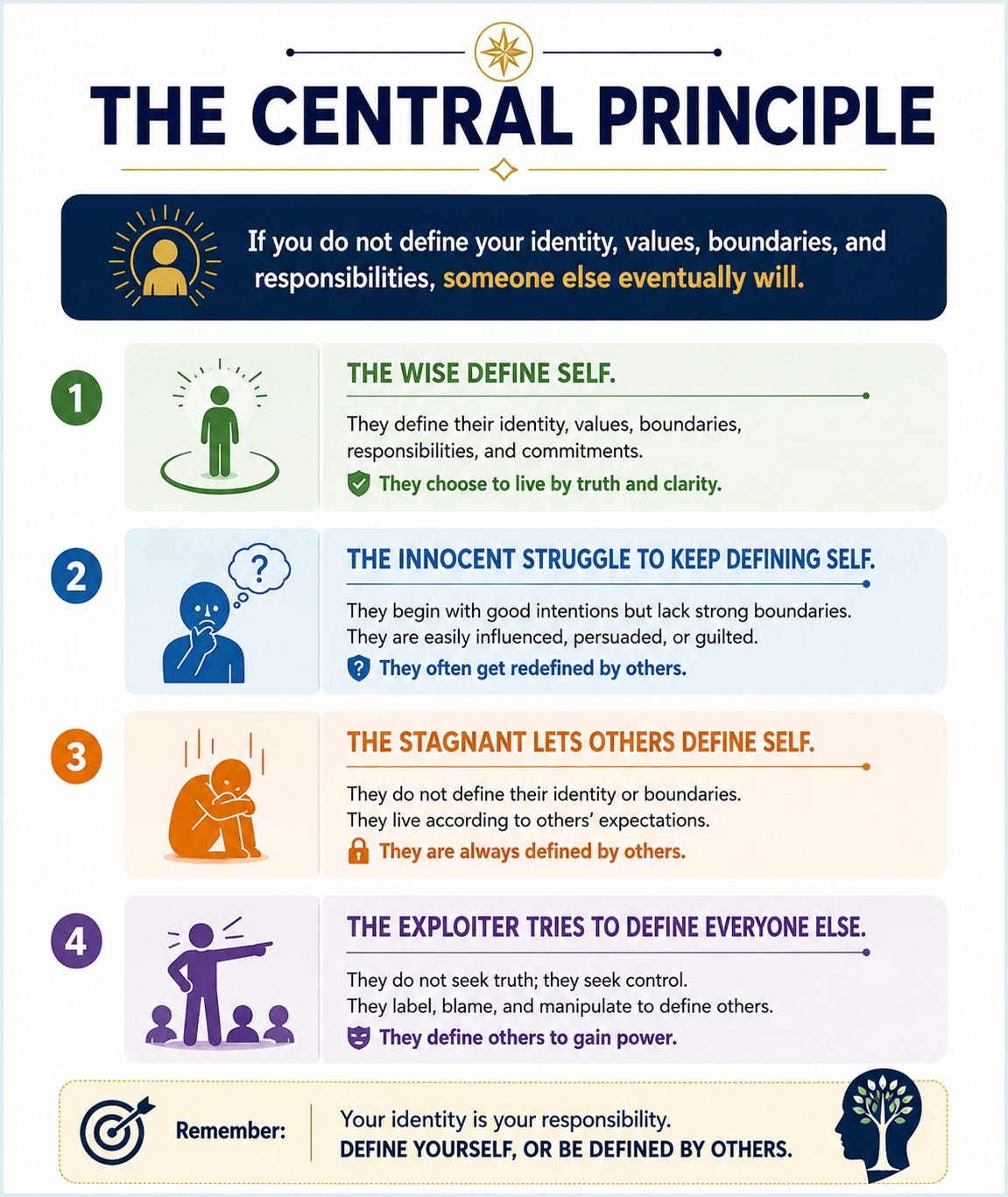
If you do not define yourself, someone else eventually will.
A healthy life is not about controlling other people. It is about possessing sufficient clarity that your identity cannot be rewritten by manipulation, guilt, praise, criticism, fear, or social pressure.
The Four Ego Types
Your framework can be understood through four distinct ego orientations.
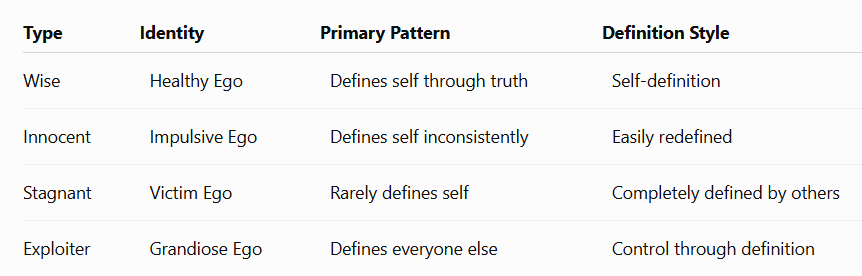
These four types do not merely behave differently. They relate differently to identity itself.
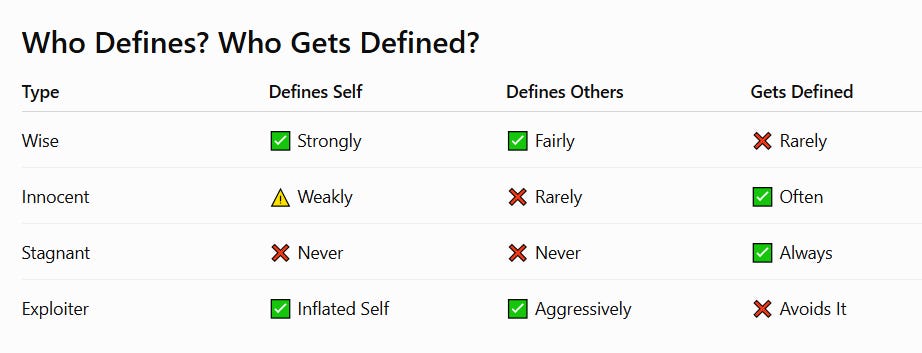
The Wise: Defining the Self

The Wise person understands that identity is not borrowed from opinions but built upon principles.
Their confidence is not arrogance. Their firmness is not hostility. Their boundaries are not rejection. Instead, they know where they begin and where they end.
The Wise clearly define:
Their values.
Their responsibilities.
Their limits.
Their commitments.
Their purpose.
Their moral standards.
Because these foundations are internally established, external pressure has little power to redefine them.
When criticized unfairly, they evaluate the criticism instead of absorbing it.
When praised excessively, they remain grounded.
When manipulated through guilt, they ask whether the responsibility truly belongs to them.
The Wise recognize that truth—not emotion—determines identity.
The Innocent: Identity Without Boundaries

The Innocent possesses kindness but lacks psychological structure.
They genuinely wish to help others, avoid conflict, and maintain harmony. However, because they have not fully defined their boundaries, they become vulnerable to stronger personalities.
Initially, they may say:
“I cannot help today.”
But after enough pressure, guilt, or emotional persuasion, they begin questioning themselves.
Soon the internal dialogue changes:
“Maybe I’m selfish.”
“Perhaps I should sacrifice.”
“Maybe they’re right.”
Notice what happened.
The conversation stopped being about the request.
It became about identity.
Someone else successfully redefined who they believed themselves to be.
The Innocent often mistakes flexibility for kindness.
Without stable principles, flexibility becomes surrender.
The Stagnant: Living Inside Other People’s Definitions
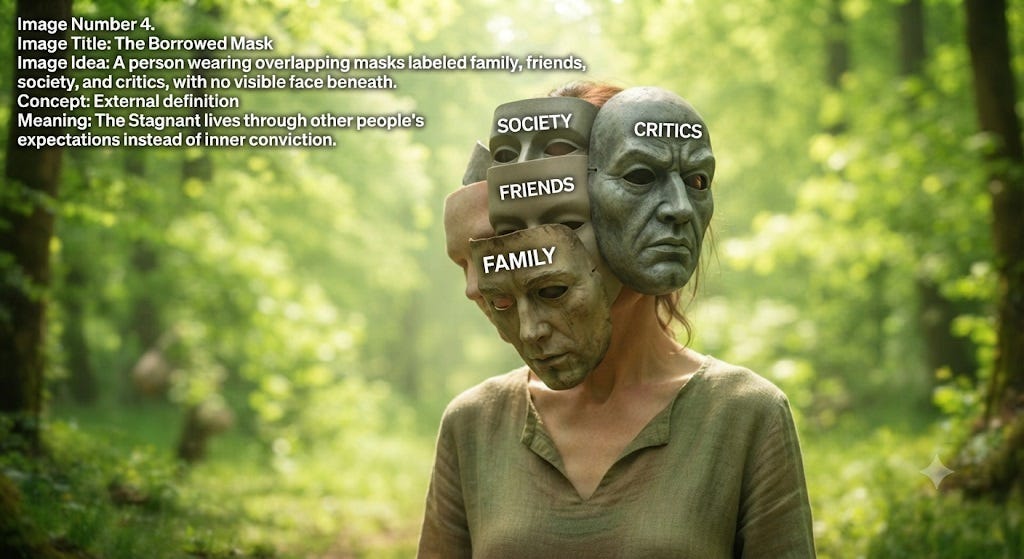
The Stagnant represents the most externally controlled ego.
Instead of asking:
“What is true?”
They ask:
“What will people think?”
Instead of asking:
“What is my responsibility?”
They ask:
“What does everyone expect?”
Their identity becomes outsourced.
Parents define them.
Friends define them.
Society defines them.
Manipulators define them.
Critics define them.
Eventually, they no longer possess an independent psychological center.
They become whatever the strongest voice tells them they are.
This creates a life filled with guilt, confusion, dependency, resentment, and helplessness.
A person who never defines themselves eventually loses the ability to distinguish between duty and exploitation.
The Exploiter: Defining Others

Unlike the Victim, the Exploiter does not surrender identity.
Instead, they attempt to control identity.
Their power comes from assigning labels.
They constantly redefine others.
“You are selfish.”
“You are immature.”
“You owe me.”
“You are responsible.”
“You are the problem.”
By controlling definitions, they influence emotions.
By influencing emotions, they influence behavior.
This explains why manipulation often begins with changing labels rather than changing facts.
The Exploiter understands an ancient psychological principle:
Whoever controls the definition often controls the relationship.
However, their identity is frequently inflated rather than integrated.
They define themselves through superiority while defining others through deficiency.
This creates dominance rather than mutual respect.
Identity Is More Powerful Than Circumstance

Most conflicts are not truly about events.
They are about meanings.
Two people may experience the same situation yet define it differently.
One defines criticism as useful feedback.
Another defines it as personal rejection.
One defines failure as education.
Another defines it as permanent inadequacy.
One defines boundaries as healthy.
Another defines them as selfishness.
The event remains identical.
The definition changes everything.
This is why psychological freedom depends more upon interpretation than circumstance.
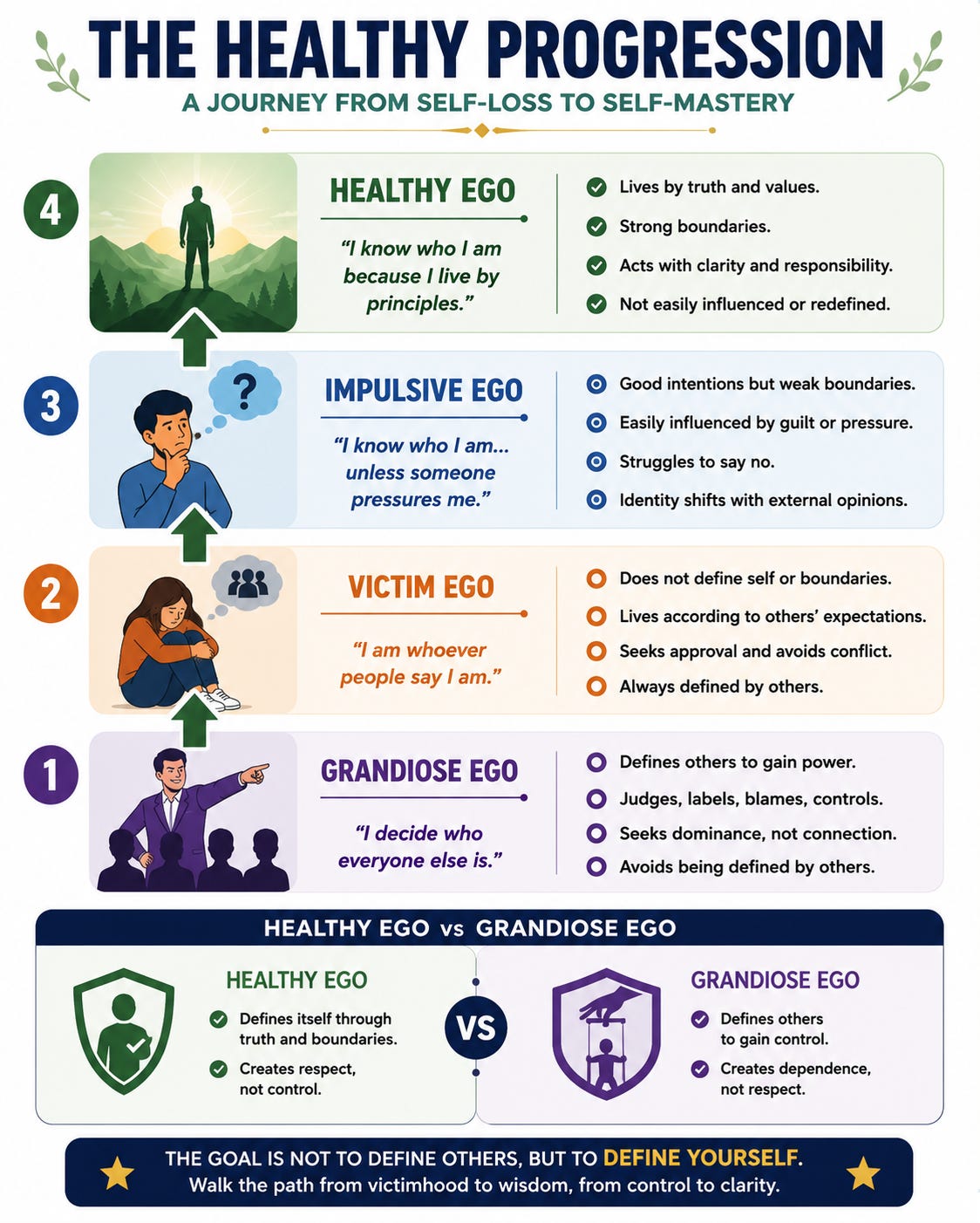
Healthy Ego Versus Grandiose Ego

Both the Healthy Ego and the Grandiose Ego appear confident.
Yet they are fundamentally different.
The Healthy Ego says:
“I know who I am.”
The Grandiose Ego says:
“I will decide who you are.”
The Healthy Ego establishes boundaries.
The Grandiose Ego establishes control.
The Healthy Ego protects truth.
The Grandiose Ego protects superiority.
One creates respect.
The other creates dependence.
Confidence without humility becomes domination.
Humility without confidence becomes submission.
Healthy Ego unites both.
The Importance of Defining Boundaries
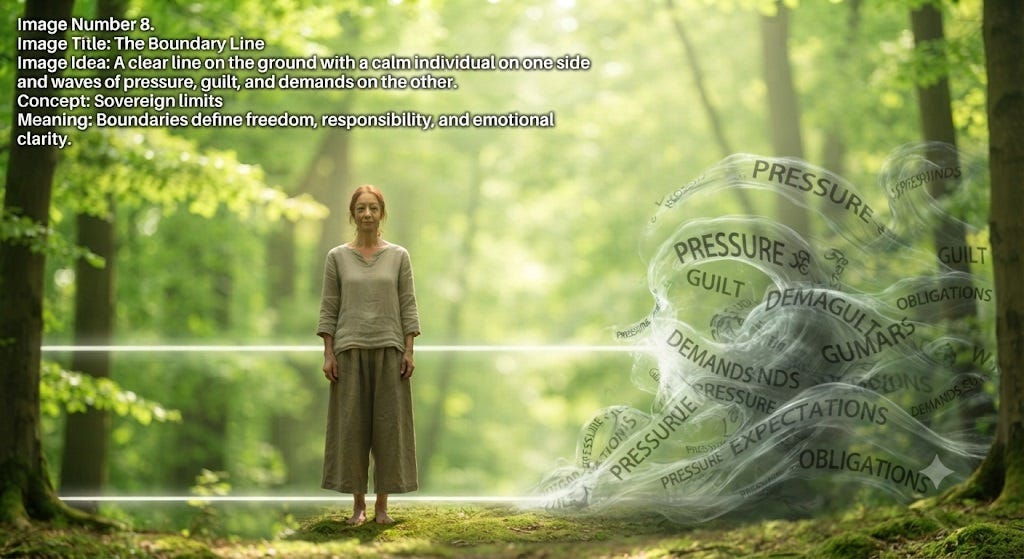
Every boundary is a definition.
Every “yes” defines commitment.
Every “no” defines limitation.
Every responsibility defines ownership.
Every refusal defines freedom.
People who cannot define boundaries usually experience:
Emotional exhaustion.
Chronic guilt.
Manipulation.
Burnout.
Confusion.
Resentment.
People with healthy boundaries experience clarity because they know where responsibility begins and where it ends.
Boundaries are not walls.
They are maps.
The Three Questions of Self-Definition
Every important decision can be examined through three questions.
Is this consistent with my principles?
Is this genuinely my responsibility?
Am I acting from truth or from fear?
These questions protect identity from emotional manipulation.
A healthy ego answers these questions before responding to pressure.
Practical Signs of Self-Definition
A person who defines themselves displays recognizable characteristics.
They accept correction without losing identity.
They reject manipulation without feeling guilty.
They help voluntarily rather than compulsively.
They apologize when wrong but not for existing.
They refuse responsibilities that do not belong to them.
They remain calm during criticism.
They evaluate opinions instead of automatically accepting them.
They protect truth even when unpopular.
These qualities emerge naturally when identity is internally grounded.
Axioms
Identity precedes influence.
Boundaries define freedom.
Responsibility defines maturity.
Truth defines reality.
Principles define character.
Clarity prevents manipulation.
Self-definition precedes self-respect.
Healthy ego protects identity without attacking others.
Maxims
Define your values before circumstances define them for you.
A boundary delayed often becomes a boundary violated.
Guilt is not always evidence of wrongdoing.
Responsibility accepted without wisdom becomes exploitation.
The strongest identity is built upon truth rather than approval.
You cannot protect what you have never defined.
Inner clarity is stronger than external pressure.
Aphorisms
Whoever defines your responsibilities controls your time.
Whoever defines your worth controls your emotions.
Whoever defines your reality influences your decisions.
A borrowed identity produces a borrowed life.
Truth strengthens identity; manipulation dissolves it.
Healthy boundaries are visible definitions of invisible values.
Freedom begins where self-definition begins.
Insights
Manipulation succeeds only where identity remains unclear.
Every act of courage begins with defining one principle that will not be negotiated.
Psychological maturity is less about pleasing others and more about accurately defining reality.
Identity built upon approval changes with every audience.
Identity built upon truth remains stable across every circumstance.
Healthy relationships respect self-definition rather than replacing it.
The greatest form of personal freedom is the ability to remain yourself under pressure.
Conclusion: The Foundation of a Healthy Ego

The central struggle of human life is not merely between success and failure, strength and weakness, or wealth and poverty. It is between living from an internally defined identity and living under externally imposed definitions.
The Wise define themselves through truth, principles, and responsibility.
The Innocent begins to define themselves but often yields under emotional pressure.
The Stagnant abandons self-definition altogether and lives according to the expectations of others.
The Exploiter attempts to define everyone else to gain influence and control.
A healthy ego chooses a different path. It neither submits to manipulation nor seeks to dominate others. Instead, it establishes a clear identity rooted in truth, protected by boundaries, guided by responsibility, and expressed with humility.
Ultimately, the question every person must answer is not whether definitions will exist, but who will create them.
Will your identity be authored by fear, approval, guilt, and external pressure?
Or will it be defined by truth, wisdom, and conscious choice?
The answer determines not only who you become, but whether you truly become yourself.